
Progress Psychotherapy is a therapy service based on the value of accessible clinical excellence. The service was founded in 2019 by Robert Fulton. He saw that effective, evidence based therapy was hard to access either due to long waiting times for statutory services or excessive costs. Bringing these to Kilmarnock (and UK wide via videocalls) has been the services goal ever since.
This page details the service policies, Roberts profile, the fees and a practical guide. Once you are ready you can check the therapy page to see what type treatment model may be best and self-refer online. If you are a mental health professional looking for clinical supervision that page details the service and lets you apply.
Progress will only utilise evidence-based treatment plans and those in line with professional and ethical standards of bodies such as BABCP, COSCA & EMDR UK. This means that some treatments that do not meet these conditions will not be utilised. The widest range of treatment options that meet this condition such as CBT, EMDR, Schema therapy, DBT & CFT are offered.
Progress should be accessible to as many people as possible. This takes 2 forms, financial access and practical access. Financial access means keeping the service affordable, at less than typical market rate. The aim should be for the service to be self sustaining while offering a reasonable wage for a therapist but no more. Where possible fees should be controlled. Fess are defined in the contract but are typically £45 per session. Fees can only be changed at the start of the new financial year in April. Clients who do not pay will have their referral cancelled.
Discounts will be offered to those that can evidence financial need.
Practical accessibility includes offering a range of therapy types, in-person or online where possible. Therapy rooms should be as accessible as possible. Clients should not be denied treatment based on complexity, except where the therapist is not qualified to work with the issues. There will be no discrimination based on ethnicity, sex, gender, sexuality, nationality, religion or other personal factors.
Progress will maintain professional standards and memberships of professional bodies such as counselling bodies, ICO and Disclosure (PVG). It will adhere to all guidance around ethics, supervision, CPD, professional conduct, confidentiality, data protection and safeguarding. Some clients may be on different payment plans relating to different incomes but Progress should avoid favouring higher income clients in referral for financial reasons.
All session content, notes, recordings and other paperwork will be confidential or anonymous. They will comply with data protection regulations. Confidence will only be broken in the following scenarios-
If confidentiality has to be broken the client will be notified.
People can self-refer online and must complete the form including the emergency contact and GP details. Failure to do so will result in the referral not being taken forward. Thereafter a contract will be issued. This can be negotiated if some aspects are not right for the person but some clauses such as those relating to ethical or professional guidelines cannot be altered. A signed contract must be agreed for service to begin (digital signatures can be accepted).
Waiting lists may be in operation and work on a first come first served basis but re-engagers may be at the top of the list (see policy below). Robert will stay in touch with people on the list approximately monthly to check in and ask if service is still required. As many people find services while on the list if people do not respond to the email to confirm that they still need the service they will be removed from the list.
Length of service will be variable depending on individual needs. Some clients complete in 6 sessions and others work with the service for years (but most are around 2-3 months). Goals should be defined and length of service is dependent on time it takes to reach these. Upon completion of all goals an ending process will occur. This can be over one session or many depending on length of time and anxiety about endings. Ultimately, the goals is to have all clients end as they recover. Clients can return after 2 months if something occurs (this to give the current treatment time to take).
The service aims to have a balance between supervision and therapy clients. Taking out teaching time, Robert has availability for around 55 therapy sessions and 35 supervisions per 4 weekly availability cycle (its done in 4 weeks to even out differences in months).
Clients are weighted based on how many sessions they get per cycle (weekly is 4 slots, fortnightly 2, etc.). When the number of client slots hits 55 I am full for therapy. Supervisees are given 25 slots in the weekday availability with 10 more via weekend video calls for 35 total. This, added to my teaching time, brings me to exactly the amount recommended by professional bodies. For this reason these numbers will not be exceeded. A table of what times are bookable can be downloaded here.
To ensure client availability isn’t drowned out the booking system is set up to allow 2 supervisions per day, thereafter appointments are reserved for therapy sessions. Any supervisee who tries to use the therapy booking section to circumvent this system will have the appointment cancelled.
Ad-hoc sessions are not recommended by professional bodies as there is evidence of treatment efficacy dropping with fortnightly sessions compared to weekly and a massive drop in success with anything less than fortnightly. However, there is a case for ad-hoc sessions among clients that have largely overcome their key issue who need occasional support to maintain their progress or phase their therapy out if we have been working together for a long time. This changes your contract to have no set allocation of sessions (weekly, fortnightly, etc.) with longer between disengagement (see policy below). You can request to be ad-hoc but key things to know are-
Waiting lists for mental health treatments are an issue so it is important to have a system to end with people who are not engaged.
Regular clients having no contact after 2 weeks will receive an automated email to check they are ok and ask if they still require the service. If they feeling better ending arrangements can be made. If a break is required this can be discussed to reduce discharge but longer term may require re-referall when they are ready. Anyone that has not replied to this email after one week will be considered to have disengaged.
Reengagement and return
A disengaged client will have 6 weeks to contact Robert and will be considered a reengager. If a waiting list is in operation they will be placed at the very top of the list. If they disengage a second time they cannot be considered a reengager and will need to start from the bottom of the waiting list. After 6 weeks they are considered a returner and will need to refer again, beginning at the bottom of the waiting list if one is in operation.
Ad-hoc clients
If ad-hoc, you will be contacted after 4 weeks of no engagement and be considered disengaged a week later if there is no contact. If you need more time just let me know and you can have another 4 weeks. In this case, there will not be a system to reengage as you were preparing to end anyway (circumstances like something happening will be taken into account).
Holiday leave will be announced with a minimum of two weeks notice. Leave may also be taken for training/CPD. It is an ethical requirement that therapists undertake the amount of CPD that professional bodies determine. In cases of emergency leave (such as sickness/ bereavement, etc) as much notice will be given as possible.
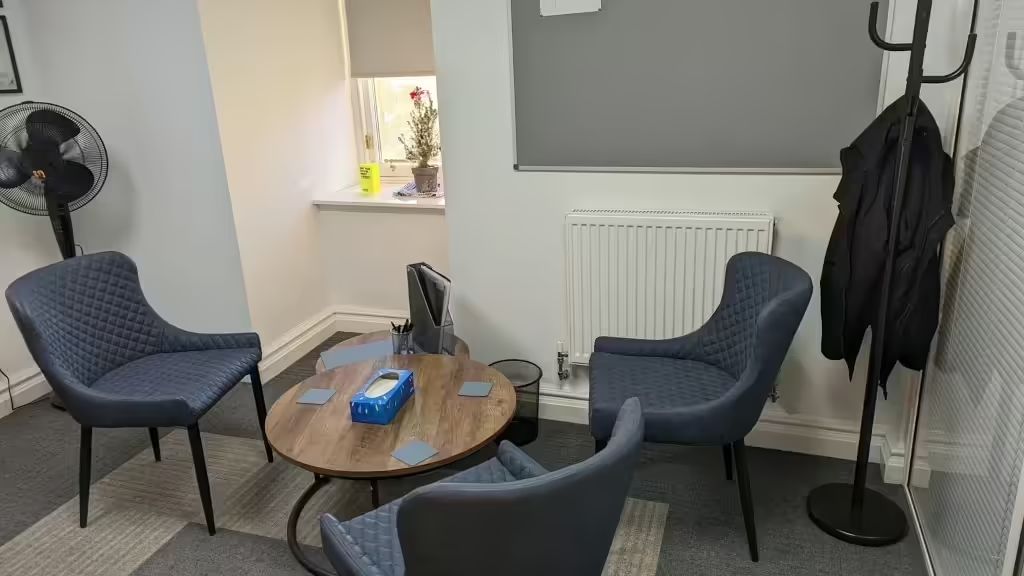
In-person sessions take place at the office in Suite 3:11, Ingram Enterprise Centre, 30 John Finnie Street, Kilmarnock, KA1 1DD. We abide by their fire & other safety policies as well as commitments to contained noise levels and keeping private and communal areas clean. This guide explains all about the visiting process.
You will attend at the centre and I will meet you in the lobby. We have to sign in for fire safety reasons. The office is on floor 3 but there are lifts for those who may struggle with the stairs. The public area has toilets and a kitchen that is shared with other businesses. My office is private and my neighbours can’t hear anything at normal talking volume. After the visit I will show you out and sign you out.
The therapist will take notes, make paperwork and have session recordings on audiotape. These will be anonymised where possible and kept in a secure locked cabinet. This supports treatment planning and enables clinical supervision.
Robert is an accredited cognitive behavioural therapist with an honours degree in psychology and a Postgraduate Diploma in CBT. He has experience of working with anxiety disorders, depression, OCD, PTSD, anger, self-harming behaviours, low self-esteem and more. In recent years, Robert has focused on work around trauma and can offer specialist support in this area, including EMDR. Robert has achieved positive treatment outcomes with hundreds of clients.
Robert founded Progress in 2019 as a way to bring therapy to as many people as possible. Robert felt that therapy is key to mental health for many people but is often inaccessible. “Private therapy often ranges from £50-80 per session. I didn’t feel comfortable with the idea of therapy being something only people of a high income can access. There are many wonderful organisations offering free services but waiting lists can be months or years long. I wanted to use my skills and qualifications to make it accessible for as many people as possible privately. Walking with clients on their journey has been such an honour”.
To Discuss your referral or if you have any questions, you can contact Robert by email.
Therapy
£45 as standard per hour. Pro-rated from there. Discounted rates of £35 can apply but these require sending evidence of low income such as a DWP benefit letter.
Group therapy is a free supplement for those getting weekly or fortnightly sessions. Those who are winding down and wish to stay with the group are charged £10 per session (unless they are on a low income and then the fee is waived).
Supervision
Those charging for their services will have a fee set at the same hourly rate they charge their clients. This can be pro-rated up for those that need longer sessions.
Students or those volunteering are charged £40 or £45 depending on income. This changes to the above rate once you begin charging clients.
Once you have completed your self-referral at the therapy or supervision pages a contract will be sent out. This may be immediate or you will be informed if a waiting list is in operation. You will be asked to sign and scan back then your referral is complete.
Sessions can take place in-person at the office in the Ingram Enterprise Centre, 30 John Finnie Street, Kilmarnock. Or online via Google Meet.